Menu

🌐
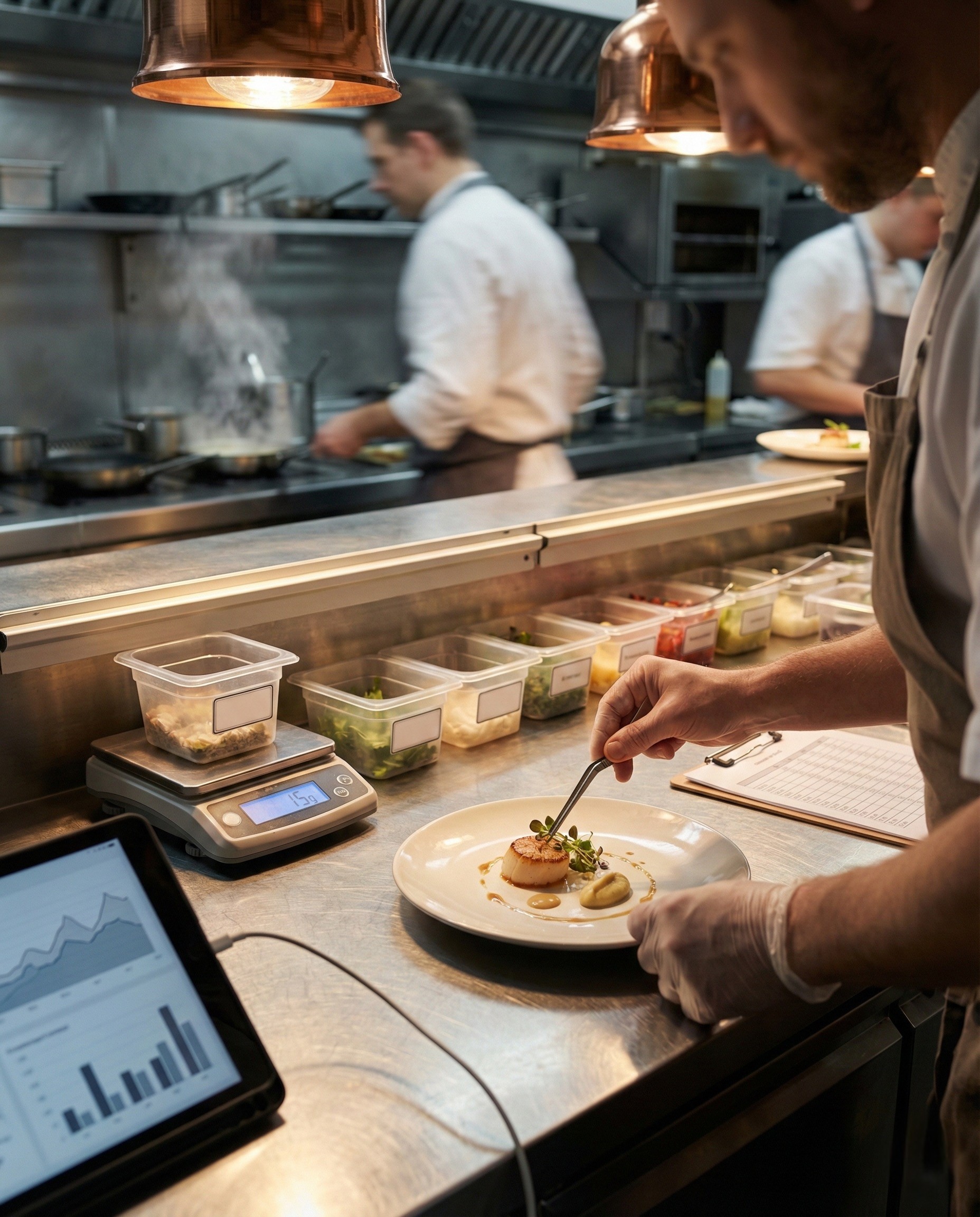
A practical look at why food cost slips in real operations—and why visibility is the first step to protecting profit.
Among all cost categories, raw ingredients remain one of the biggest and most controllable drivers of margin. The problem is that food cost often doesn’t “spike” in a way you can easily see during service. It drifts through small inefficiencies, repeatable waste, inconsistent portioning, and gaps between what you think is happening and what is actually happening. That’s why margin control quickly turns into guesswork.
Standardization is often misunderstood in restaurants. It’s not about turning your kitchen into a factory or removing personality. It’s about making the business repeatable.
The moment you put a dish on the menu, you’re making a financial promise: that you know roughly what it costs, you can execute it consistently, and it produces a margin you can rely on. That promise collapses when recipes become optional, portions drift, or “how we do it” depends on who happens to be working that night.
When standards are clear, the operation gets calmer. People spend less energy improvising, less time debating, fewer minutes correcting avoidable mistakes. The day feels more stable and stability is one of the quiet ingredients of retention, quality, and profit.
Spreadsheets can work on paper, but restaurants run on speed. In most SMEs, margin control loses the battle against urgent reality: service, staffing, customer experience, supplier issues, equipment problems, last-minute surprises, admin tasks. The “important but not urgent” work (like deep cost analysis) gets pushed later. Later becomes next week, next week becomes next month, and then you’re back to end-of-month guessing.
This isn’t a discipline problem. It’s a design problem. If the system depends on manual updates and extra hours you don’t realistically have, it won’t survive a busy season.
Margin control becomes easier the moment you can connect what you sell to what you consume without having to rebuild the puzzle by hand every month.
That’s where a digital inventory approach matters: not because it’s “tech,” but because it creates traceability. Conceptually, the logic is simple: you know exactly which items were sold, each menu item is connected to a defined recipe, and you can compare what should have been used with what is actually left in stock.
That clarity what was sold, what should have been consumed, and what is physically there helps you pinpoint where money is leaking. Instead of staring at one generic food-cost percentage, you start seeing which products, stations, or habits are driving the variance. And once you know that, you can intervene in a targeted way: not “cut costs everywhere,” but fix the few leaks that actually move the number.
In hospitality, profit rarely disappears in one dramatic event. It disappears in small, repeated, unmeasured inconsistencies.
The solution isn’t more pressure. It’s more clarity: standards that reflect real life, measurement you can trust, and visibility that lets you act on specific causes instead of guessing. When you can see where money is leaking and why you can build targeted strategies around the real problems, without drowning in admin or giving away your entire playbook.