Menu

🌐
Why non-alcoholic options are no longer a compromise, but a reason to choose your venue.
In 2026, restaurants across Europe are starting to feel a shift that was easy to dismiss a few years ago: many guests are drinking less alcohol, more intentionally, and more selectively. The change is not always dramatic at the table often it looks like one person in a group choosing a non-alcoholic option, or someone alternating drinks across the night—but the direction is becoming harder to ignore. The underlying driver is also changing: for a growing share of customers, alcohol decisions are increasingly linked to wellness, performance, and the belief that food and drink have a real impact on the body.
Switzerland offers a clear long-term signal. The country’s average annual sales of pure alcohol per person fell from 10.6 litres (2001) to 7.6 litres (2024), driven largely by a decline in wine, while beer and spirits were comparatively stable over the same period. At the same time, the share of people who drink alcohol daily has fallen sharply over decades. According to the Swiss Federal Statistical Office, daily alcohol consumption dropped by about two-thirds between 1992 and 2022—among men from 30% to 12%, and among women down to around 5%.
This doesn’t mean “nobody drinks.” It means alcohol is increasingly treated as an occasional choice—often a weekend, a celebration, or a specific moment—rather than a default part of everyday life.
One reason this matters so much for hospitality is that drinking patterns now vary widely inside the same table. In the same group you may have someone driving, someone working early tomorrow, someone pregnant, someone training for a race, someone “sober curious,” and someone who still wants a cocktail. Guests don’t necessarily want a binary world of “alcohol vs no alcohol.” They want the dignity of choice: to feel that their decision is normal, supported, and still enjoyable.
For restaurants and bars, this reframes the opportunity. Non-alcoholic options are no longer “what we offer when someone can’t drink.” They’re a way to make the experience work for the entire group—keeping everyone engaged, keeping the table together longer, and avoiding the awkward dynamic where one person feels excluded from the ritual of an aperitif, a toast, or a pairing.
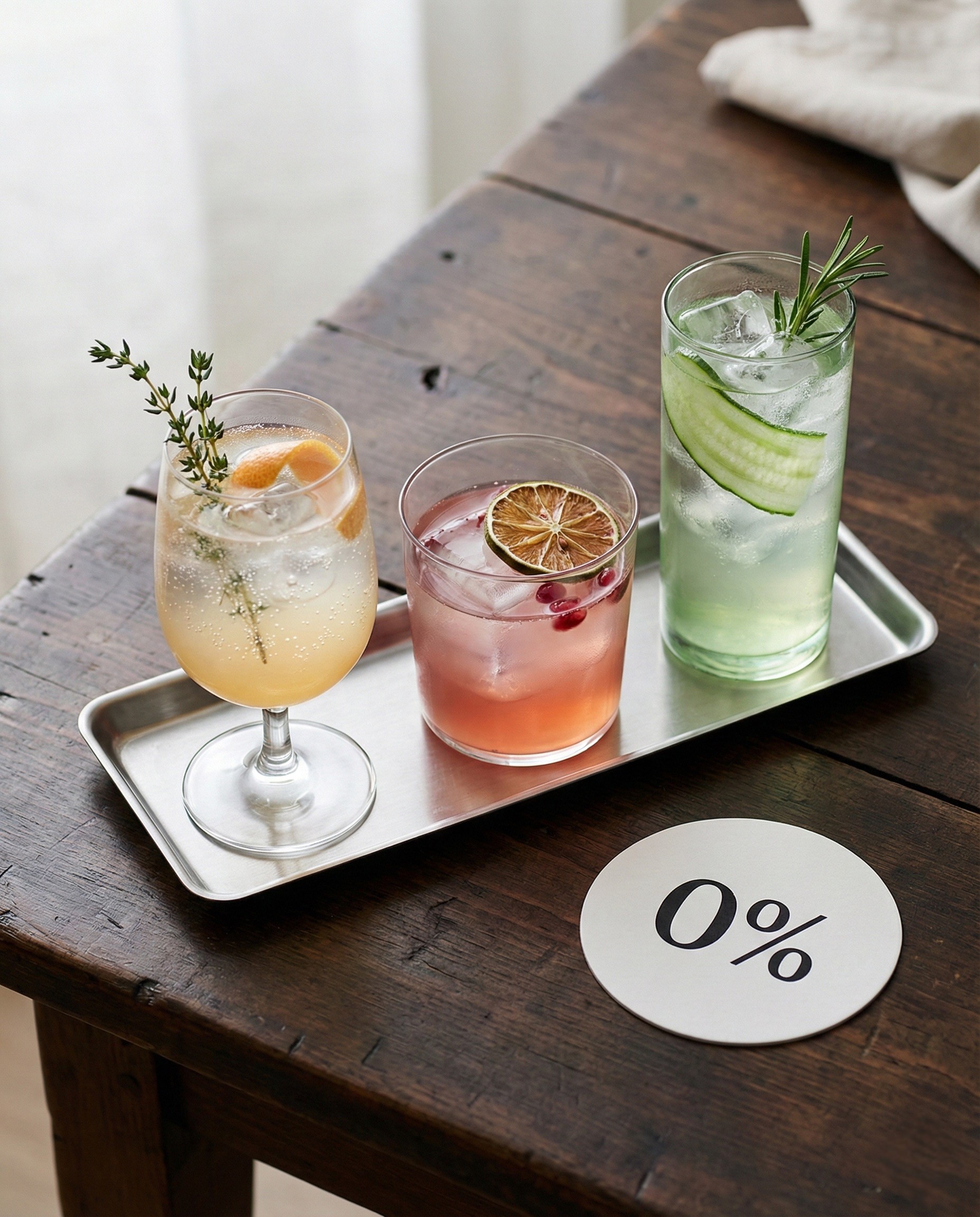
The biggest misunderstanding in hospitality is thinking the non-alcoholic demand is mainly for soft drinks. In reality, what many guests are looking for is a grown-up beverage experience with the same emotional function as alcohol: a sense of ritual, taste complexity, and a clear “this is special.”
That often means flavours that behave like wine and cocktails: bitterness, acidity, botanicals, spice, smoke, tea tannins, fermentation notes. It also means presentation that carries status: a proper glass, thoughtful garnish, a name that feels intentional, and menu positioning that signals this is a real choice, not an afterthought.
This is where fermented options become interesting in 2026 not as a fad, but because fermentation naturally creates complexity, texture, and “adult” flavour without relying on alcohol. When done well, these drinks don’t feel like substitutes. They feel like their own category.
Moderation doesn’t reduce the need for enjoyment. In many venues, drinks are part of the entertainment: the start of the evening, the shared discovery, the thing you talk about. If a guest’s non-alcoholic path is limited to water, soda, and one generic juice, the message is subtle but strong: this place is not designed for my moment.
That can have real consequences. The group might shorten the evening. A guest might choose another venue next time. Or they might skip the second round. And in a market where margins are often under pressure, losing beverage excitement is one of the fastest ways to lose high-value revenue without noticing it immediately.
The opposite is also true: when the no/low offering is compelling, it can become a reason to choose a venue. People remember places where everyone in the group had something interesting, not only the drinkers.
The smartest way to frame this in 2026 is not as a moral position and not as a radical replacement. It’s as an expansion of options for real people in real moments.
For restaurants and bars that want to innovate, the opportunity is straightforward: give non-alcoholic drinks the same dignity you already give wine and cocktails. Not by overcomplicating, but by making the choice feel adult, exciting, and genuinely worth ordering.